
Featuring Brian Zapf
Learn how better financial management can lower stress for law firm owners and make their firms more profitable and stable. In this episode of the Alpha Lawyer Podcast, Jason Marsh interviews Brian Zapf, fractional CFO and founder of Flight Financial. Zapf explains why wellness and self-care alone do not fix burnout when the firm's financial environment keeps creating pressure. He also walks through the three parts of a firm's financial machine, revenue, profit, and cash flow, and shares a simple monthly process for setting targets and reviewing the numbers.
Watch the Episode
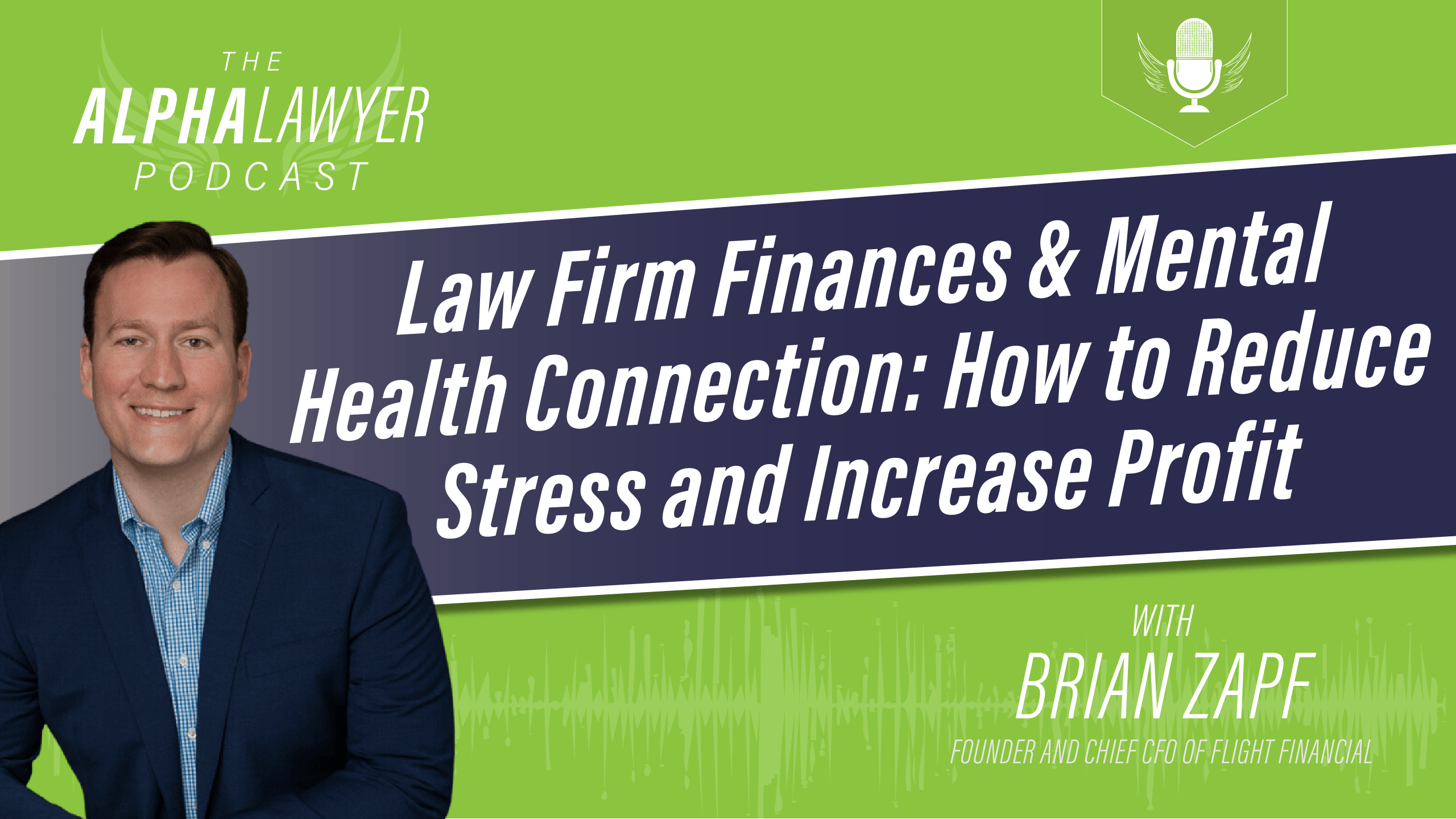
Click to Watch
0:00 Introduction to Brian Zapf & Flight Financial
2:03 Why Lawyers Experience High Levels of Mental Health Struggles
5:10 The Link Between Law Firm Finances & Mental Well-Being
8:45 The Trap of the Billable Hour & How It Impacts Lawyers’ Self-Worth
12:19 Shifting Your Mindset from Lawyer to Law Firm CEO
15:38 The 3 Key Financial Pillars Every Law Firm Needs
18:50 How Poor Cash Flow & AR Management Creates Stress
22:47 The Power of Systems: Removing Yourself as the Bottleneck
27:19 The First Steps to Financial Freedom as a Law Firm Owner
30:32 The Long-Term Benefits of Financial Stability in a Law Firm
34:18 Free Financial Assessment: How Brian Can Help Your Firm
Listen to the Episode
Watch or listen on your favorite platform
Key Takeaways
- Address the financial causes of stress, not just the symptoms. Brian Zapf argues that wellness and self-care matter but work like a bandage when the stressful environment stays the same. Reducing financial stress and pressure in the firm often improves mental health and wellness as well.
- Think of yourself as the CEO of your firm, not its chief lawyer. Zapf explains that running a firm takes a different skill set than practicing law, and law school does not teach it. Owners need a firm that makes money without them doing all the work.
- Measure success by profit and cash flow, not revenue alone. Zapf points out that a firm can bill a great deal and still keep very little. Watching expenses and how funds are allocated lets owners keep more, do less work, and have more time for what matters to them.
- Collect payment up front instead of chasing receivables. Zapf says firm owners should not be the ones following up on accounts receivable, because it adds work and strains client relationships. He prefers a preventive approach that collects cash at the start of the engagement.
- Review your numbers against clear targets every month. Zapf recommends setting financial targets, understanding where the firm stands today, and building a roadmap. He says even an hour a month spent comparing results to targets and choosing one to three focus areas is enough to start.
You really have to look at the overall financial environment of the firm, and if you can alleviate the financial stress and pressure, you often improve the mental health and wellness as well.
Brian Zapf
Episode Breakdown
Recognize How the Billable Hour Drives Burnout
Brian Zapf sees the billable hour as a major source of stress for lawyers. Many attorneys tie their self-worth to how many hours they bill, a mindset that starts in large firms and trickles down to smaller ones.
Zapf notes that younger lawyers do not want to work the same hours, and more firms are experimenting with value-based pricing and fixed fees, though there is a long way to go.
Firm owners face added pressure. On top of billable hour demands, many feel everything rests on their shoulders, and the other lawyers in the firm may be partners without being business partners.
Zapf says burnout hurts professionalism, makes lawyers less responsive and adaptable, and slows their work. Many also take that stress home, where it affects their personal relationships.
Fix the Financial Environment, Not Just the Symptoms
Zapf agrees that wellness and self-care are important, but he compares them to putting a bandage on an injury. The stressful environment that caused the problem is still there, and improving the firm's financial environment often improves mental health and wellness as well.
Lawyers start firms because they are good at practicing law, but running a business is a different skill set, and law school does not teach it. Jason Marsh connects this to the ideas in The E-Myth.
Zapf describes a lawyer named David who drives a new Mercedes and takes exotic vacations. His firm is profitable on paper, but success does not feel like success. Owners in this position often return from vacation to chaos and feel they must accept demanding or lower paying clients because they worry the work will dry up.
Zapf says this is a common stressor, and many of these pressures do not show up on a profitable firm's books.
Build a Firm That Does Not Depend on You
Jason raises the idea, associated with Robert Kiyosaki, of living below your means to create a financial buffer. Zapf adds the related idea of accumulating assets that generate income, which is hard for law firm owners because so much of their income depends on their own ability to deliver the work.
Many owners trust their team with some tasks but still feel they must keep their hands on everything. Zapf explains that this limits how far the firm can scale.
He also points to key person risk. David worried that if something happened to him, the business would dry up and leave nothing for his family. The goal is a financial machine that supports your lifestyle and is a sellable asset even if you are not doing the legal work.
That requires a shift in identity. Zapf says your job is not chief lawyer but CEO of your law firm. He likes the saying "you can't read the label when you're stuck inside the jar," and suggests carving out even an hour a week to look at where the firm is, where you want it to go, and where you are the bottleneck.
Focus on Profit and Cash Flow, Not Just Revenue
Most lawyers judge their success by revenue. Zapf gives the example of a firm billing tens of millions of dollars while keeping only a couple hundred thousand, which he calls unsustainable. A firm that bills less but watches its expenses can keep more and give the owner more time.
He breaks the financial machine into three parts. Revenue is the money coming in from clients or referral sources, and profit is what you keep on paper after paying your team, marketing, operations, and overhead. Cash flow is what actually reaches the bank, and it can be hurt by slow collections, paying suppliers promptly, taking on debt, or buying expensive assets such as real estate.
Chasing unpaid bills is an extra job that often falls on the owner and can damage client relationships. Zapf says owners should hand this to a team member or a third party, and he prefers collecting cash up front at the start of an engagement.
Install a Simple Monthly Financial Review Process
Zapf names three challenges owners face. The first is the mindset shift itself, the second is finding time when legal work takes up the day, and the third is knowing what to look at. Many lawyers do not know how to read a P&L or balance sheet, or they do not use those numbers strategically.
His answer is a financial management process. It starts with clear financial targets, an understanding of the firm's current financial health, and a roadmap from where you are to where you want to be.
Each month, at a minimum, the owner reviews the numbers, compares them to the targets, and picks one to three key areas to improve. Zapf says even an hour a month is a meaningful start.
He compares this to the approach in James Clear's Atomic Habits. Starting small is how you build a sustainable practice.
Bring Your Team Along and Take the First Step
Zapf explains that financial stability spreads beyond the owner. Once the owner identifies the gaps and systems the firm needs, the team starts to buy into the vision. They see a more stable firm, growth opportunities, better clients, and possibly fewer hours.
A happier team leads to happier clients and a better client mix. If many firms take this approach, Zapf says, the profession as a whole benefits. He encourages owners to let people do what they are good at and love, give them the resources they need, and get out of their way.
For a first step, Zapf suggests blocking off a specific hour on the calendar, even on a weekend if the week is too busy. Pull your financials if you have them, and ask yourself whether you are happy with your work, where your time goes, what drains your energy, what gives you energy, and "if this was easy, what would it look like?"
Zapf notes that there is an overabundance of information available, and if a lack of information were the only problem, every firm would be financially successful. He suggests talking with a professional who has worked with law firms, and he and Marsh both stress the value of having someone to be accountable to.
Jason Marsh (00:00)
On today's show, Brian Zaff, fractional CFO and founder of Flight Financial. Today, we'll be talking about the connection between law firm financial management and mental health.
Brian (00:13)
you really have to look at the overall financial environment of the firm and if you can alleviate the financial stress and pressure, you often improve the mental health and wellness as well.
Jason Marsh (00:24)
Welcome to the Alpha Lawyer podcast, a show dedicated to exploring what makes law firms thrive. I'm your host, Jason Marsh. Join me as I interview some of the smartest thought leaders and accomplished law firm owners in our space. Together, we'll dive deep into law firm operations, marketing, technology, finance, and everything else you need to build an incredible firm that allows you to live your best life.
Jason (00:52)
Hey there, welcome to Alpha Lawyer podcast. I'm Jason Marsh. More importantly, I'm here with Brian Zaff and Brian, he's a fractional CFO for law firms. He's the founder and chief CFO of Flight Financial. But what he does is he helps all firm owners reduce their stress by improving the financial management and
performance of their firm. But Brian, I wanted to talk to you because you recently wrote a really interesting article.
in the American Bar Association's Law Practice Today publication, which I'll share in the show notes. But you make a really interesting connection between mental health issues and then the financial setup of a law firm. So I'm really interested to talk about that. But before we get into the financial component, I really want to talk
about the mental health aspect because I do see that coming up more frequently. And you highlight that lawyers are
twice as likely as non-lawyers to experience suicidal thoughts, 70 % report, anxiety. I mean, does it seem like this is something new or is the legal profession experiencing some sort of mental health
crisis?
Brian (02:02)
Yeah, I think, and if we look at the recent survey results, over half of the respondents say they believe that mental health is at a crisis level for the industry, but some of it's just
Jason (02:13)
That's a lot.
Brian (02:14)
the way it's always been done, right? Lawyers expect to work long hours to constantly be on call trying to service clients.
And so some of that is natural that it leads to burnout, but I do, it does seem that in recent years that this has kind of escalated.
Jason (02:32)
Yeah, because I know just seeing in other publications, I know a topic that I see just come up, and because I also am an editor of
Law Practice Today. And so I see this topic circulating a lot over
Brian (02:43)
And so I see this topic circulating a lot.
Jason (02:46)
the course of a year. I think there's even sometimes issues dedicated to mental health and the legal profession. it's just, I wonder, is there something about being a lawyer in particular that makes
than more susceptible to these mental health niche. That's different. And I know you work with some other types of entrepreneurs, but is there something inherently different about being a lawyer?
Brian (03:14)
big thing is just the billable hour because for a lot of lawyers it's just their sense of self-worth.
or self-worth is tied up in just how much they're billing, what their hours are. I mean, that's kind of the way these large, you know, the big law firms run it, and then that trickles down to the smaller firms as well. So when you feel like you're only as good as how many hours you're billing, it kind of creates this vicious cycle.
Jason (03:39)
Yeah, it's almost like you're really, really quanti- just, just quantifying
a person's value, professional value, whether it's hours, rates, you know, the combination of those two things, right?
Brian (03:53)
Yeah, exactly. And I do think we're starting to see, I think there's just more mental health awareness going on as well. And the legal industry is seeing that. And the younger generation of lawyers, they don't want to work like the same hours. So we're starting to see more experimentation with value-based pricing models for law firms, kind of fixed fee approaches. But there's still a long way to go with it.
Jason (04:18)
And in terms of this type of stress and burnout and ultimate mental health issues that come out of those things, is it more particular to large firms where the billable hour is everything? Or is it smaller firms where you have like a firm leader that's also has to do billable hours, but also has to run all the admin of the firm in a lot of cases and juggling all of those tasks.
Brian (04:44)
And I think it depends. Like if you look at the recent reports on this, mean, definitely the large firms, there's a well-known just kind of...
crisis level of burnout, but then at the small firm, you add on not only the billable hour pressures, but also, yeah, right? A lot of these owners feel like it's on their shoulders that everything rests with them, and maybe they've got other lawyers who are partners, but those lawyers might not be business partners. So it's kind of additional challenges that they're taking on.
Jason (05:14)
Yeah, it's interesting when you look at that. so what typically, when
you see the manifestation of someone that's experiencing all of the whatever, whether it's mental health
challenges, burnout, how does that actually impact their work and professionally? And then the follow-up is then how could that possibly impact their personal
life and overall wellbeing?
Brian (05:39)
That's a great question and the answer really is that it has a negative effect and they've actually done studies on this as well that you know your professionalism takes a significant hit, you're less able to respond to client demands, you're less adaptable, just it takes you longer to get work done. So it has a quantifiable impact if they took the time to see how many billable hours were at risk with this. It does affect the professionalism which
affects the industry as a whole. And then a lot of lawyers will take that stress home with them too, so it's obviously affecting their personal relationships as well.
Jason (06:18)
Yeah, I mean, it's interesting, and I certainly can relate to this as an entrepreneur, just having all the hats you have to wear and you're responsible entirely for your income and have to, sometimes you can feel like you're on a treadmill, especially those early days, right, before you've
built out a team and processes and support and, know, things we're going to talk about that make that transition. just in reading your article, it was talking about how
lot of the current solutions, and again, I see this like in other articles that are written, the real focus when it comes to mental health,
solving that stuff is just really on wellness and self care. And obviously those are important things, not saying they're not.
Brian (07:02)
Yeah, yeah, mean, it really is. Wellness and self-care are definitely important, but it's almost like putting a band-aid on the injury because you still have the same stressful environment that created that stress in the first place. So...
It's like, kinda, and what I talked about in the article is just you really have to look at the overall financial environment of the firm and if you can alleviate the financial stress and pressure, you often improve the mental health and wellness as well.
Jason (07:34)
Yeah, and it makes so much sense. make a great point. It is like putting a bandaid on it. Obviously working on wellness and self care is important really no matter what you're doing or level of
stress. But if you have this incredibly stressful job and you're not fixing the root causes of that, well, that stuff isn't going to change. Now, maybe you can handle those things better, but there is a better path, right? Wouldn't it be much nicer? And you point out, and I think this is like for anyone that's ever read
like the E-Myth, right? It's like lawyers start out, they start law firms because they're good at practicing right? Or good at practicing law, not because they understand financial strategy or how to run a business or what investing in a business or any
of those things. And honestly, I look at my, started a business 15 years ago. I probably would have never done it if I actually knew what was involved. Fortunately, I was just too dumb to know that there's a lot to it, but
But yeah, you start a law firm, you're good at practice in law, that's what you want to focus on. But all of a sudden you find out, well, how do you get clients? How do you manage those clients? Then you got to do the work, you got to
bill for the work, you've got to follow your tout, you got to do all these things. so, yeah, I mean, they're just, they're not set for it.
Brian (08:51)
No, it's like a completely different skill set that you're not trained on and you the public school system definitely doesn't educate you and you don't learn about it in law school so...
Jason (09:02)
Yeah, you would think at some point law schools,
I don't know what the mission of a law school is. Obviously, it should teach you about the substance of the law, but it seems like there maybe could be some electives on how to start a law firm, things you should know. it's like you tell a story about a lawyer named David in the article. And what jumped out at me is you talk about, he's got the brand new Mercedes, he's taken the exotic vacations and so forth.
And
by all accounts, you look at that and you're like, that is a very successful practice. But what you don't realize is in the background is, there's a lot of plates in the air, feeling a lot of like weight on his shoulders. That this could all fall apart at any time if, his marketing stops working as well. You've got a couple unhappy clients, some bad reviews. And, and so can, yeah, can you speak, I don't know if that was like a an example of someone that you've actually worked with.
Brian (09:58)
It was and it's a common kind of stressor that I hear when I talk to law firm owners is that Success doesn't feel like success right like they're profitable on paper But they feel like it's like you said it's all on their shoulders like if they step away to take a vacation when they come back They feel like things are chaotic They they always feel like they have to accept all these maybe more demanding or lower paying clients because they worry the worst
will dry up so there's a lot of stressors you don't just see by seeing this is a profitable firm on paper
Jason (10:33)
Yeah, and has all the trappings around it, nice office, nice car, know, all nice home. Yeah, but you know what struck me as I was reading that? I mean, because it is kind of a classic case of not just for lawyers, but how
a lot of people, even entrepreneurs, as their income increases, they also increase their lifestyle and their lifestyle expenses. And so the weight of all of that, whether, I don't know if you read
Robert Kiyosaki or other people. It's like the idea that financial freedom and a path to wealth is all about living below your means or even in some cases, well below your means so that you don't have that pressure to make the house payment, the car payment, go on the expensive vacation, but rather you have a buffer financially. You don't have the stress, right? Like
Brian (11:25)
Yeah, exactly. And I think the other thing that Robert Kiyosaki talks about is just accumulating assets that generate income for you. And that's part of the challenge with being a law firm owner too, right? Is that a lot of the income is tied to your ability to deliver that work. And a lot of law firm owners, they don't feel like they can delegate and trust. mean,
Maybe they can trust their team to do certain things but at the back of their mind they feel like they've got to keep their hands on everything and When you do that it kind of limits where you can scale to right? Yeah, there's only so many hours and so much energy in a day So part of what I sorry, go ahead
Jason (12:05)
Yeah, I was just going to say it could be, because that is a thing and any entrepreneur, you read about the founder in this case. And
here's one thing that I do find, I don't know if you've come across this, but in line with what we talked about before is a lot of lawyers, they start practices because they enjoy it and they see themselves as practitioners and forget about the fact that you're a business,
a small business owner now. You are an entrepreneur above all, even before you're a lawyer.
legal services is what you offer, but, but people don't realize and then they get very stuck working in the business. Right. And yeah, there's always working in the business, working on the business, working above the business, all these different ways of removing yourself. Because even before we
started this recording, we were talking a little bit about small business M and A and, one of the things is obviously, you know, the saying goes the more dependent, the more your business
The more valuable you are to your business, the less valuable your business is. So you've got to find a way to begin to build a process and a system that can work independently of you. and of course, when you do that, I think stress levels can come down
quite a bit.
Brian (13:16)
a hundred percent, because then you don't feel like you're tied to whatever the outputs are. It's like your inputs get magnified. And especially for a firm like a law firm, right? Key man risk is a very real problem, because if something happened to you, like in the David case study, right? If he had a heart attack, he was worried that the leads would dry up, that the business would dry up, and then what's he leaving for himself or for his family?
So you know like like you were saying you've got to figure out a way to build a financial machine that can make money to support your lifestyle and be a sellable asset Even if you're not actually doing the legal delivery work
Jason (13:58)
Yeah. it's unbelievable. Yeah. And I want to get into that before, in terms of the biggest thing I took from David and just to back up, like,
I don't know where, maybe this is Robert Keat, but, you mentioned this in your article and that's why I want to emphasize it. Cause we're to get into how you can start to address these things, but it really isn't about how much money you make. It's how much money you keep. Right. And so it's like, I think.
You talk about the idea that to start to create some stability and to find growth that
law firm owners, have to change your mindset. You have to start to think about your law firm as an investment or like it's a machine that can have a process that can produce results consistently and efficiently.
Brian (14:45)
Exactly, and on that mindset point, like your job really isn't chief lawyer, right? It's CEO of your law firm and it's just a different kind of set of skills that you need to bring to that role.
Jason (15:00)
Yeah. And I guess, so then the question becomes how do you move from that from being the legal practitioner to getting to being that CEO type level that's providing, vision and strategic direction and overseeing,
the moving parts of the business. I love the analogy that you use as a law firm
as a machine. And it
has these, three parts, revenue, profit and cashflow. But
Before we get into those, can you talk about how this mindset shift really can make a difference for law firm? Because I think this is in a nutshell,
what we're talking about here today.
Brian (15:38)
Yeah, and it's really like kind of your self identity like, okay, you're you're a lawyer, but now you're also a business owner and it's I love the saying that it's you can't read the label when you're stuck inside the jar. So you really have to find it and whether that's carving out dedicated time, maybe even just an hour a week to start to kind of start to see, okay, where is my business today? Where do I want it to go? And then backing into
what's that roadmap look like? honestly, if you're okay being stressed and with your firm where it is, okay, you don't need to change, but if you wanna be able to make your firm less reliant on you, you've gotta figure out kind of where are you the key bottleneck in some of these processes and how do you start backing out of that? And it starts with creating, sorry, go ahead.
Jason (16:32)
It's interesting. Have you
met lawyers that are like, I'm perfectly happy with the stress. I'm good to just continue on as is just in in the David approach. It's like, hey, we're going to keep on this treadmill, making money, spending a lot of money. But I'm happy with that.
Brian (16:49)
I feel like that's what a lot of lawyers, at least the old school mentality will say, right? It's like working long hours, having those trappings of success. That's a badge of honor for a certain type
Jason (17:00)
It's like the grind.
Brian (17:01)
of lawyer. And then I feel like there's a lot of lawyers today, though, especially after like COVID and the pandemic, right? Who did a lot of soul searching and they realize, I don't wanna be that 49 year old or the 50 something lawyer who still has to
hustle and keep going to court and doing all this kind grinding legal work and not necessarily having anything to show for it at the end of the day.
Jason (17:27)
Right. And having a life. so, yeah, because in
terms of that, like you talk about, like most lawyers, they weight their financial success with revenue and that's it, right? And we're talking about it's not how much you make, it's how much you
keep. So why is it so important? It's okay. Revenue is important. You need that. But why is
it so important to shift the focus to profit and cashflow?
Brian (17:51)
Yeah, because, you know, like you said, right? Like a lot of lawyers focus on their revenue and how much are we billing, but...
You can be billing tens of millions of dollars, but if you're only keeping a couple hundred thousand dollars of that, you've got a problem. That's not sustainable. Whereas you could bill a lot less, but if you're monitoring the expenses and where you're kind of allocating your funds, you can keep a lot more, which means you can do less work and have more time for the things that matter.
Jason (18:23)
Yeah, I mean, isn't that the thing? Like, can you imagine a scenario where you have a business that can generate 10 million or more in revenue, but you're only taking for yourself a few hundred, like the amount of work and stress to manage what it takes to generate $10 million. And then that's all you can bring home. And that's that's a nice, if anybody can bring home a few hundred thousand dollars, listen, that's an excellent income. No question about it, but just in terms of.
the what you're actually dealing with and that you could have probably, would imagine. mean, I want to talk about profit. I do have a question. of what
is a good net profit margin? We'll get to that in a second, but you also talk about how
lawyers often as they just don't have the financial, they don't have any financial strategy whatsoever. And as a result, that's why all they can do is look at the top line revenue. And that's an indicator of how we're doing.
This year, last year, that's a number we can look at, it's not the only metric. And the reality is it's not the most important metric.
Brian (19:25)
Well,
it's not and you really have to start with figuring out like what's most important to you? Like what what do you value? What do you want out of life? if what you want is to work a whole bunch of hours and just bill as much as possible, okay, but if you want to do meaningful legal work, but also have time for other pursuits, maybe travel or for family or whatever, that's a different type of firm you need to think of how you design.
Jason (19:53)
Yeah. so, so, okay.
So let's talk about the machine and the three key parts, right? The three pillars of a successful firm, you put it, revenue, profit
and cashflow. Can you just talk about each one of those
what each one is, why those, why that individual one is important?
Brian (20:13)
Sure,
yeah. And revenue, that's what you're billing out. That's kind of the money that comes into your firm from client payments or referral sources. And then your profit's what you're keeping, at least on paper, after you cover all the expenses to pay your team, pay for marketing, pay for your operations and overhead. And then obviously profit on paper is not necessarily the same thing as cash in the bank, right?
Collections are a huge problem. There's a lot of law firms that have these long-standing accounts receivable and that hurts your cash flow or you know, if you're a prompt payer on paying your suppliers, you know, that's great for them, but that's also hurting your cash flow or you know, if you're taking on debt or you're buying a lot of assets, you've got, you know, expensive real estate that you're making improvements to all that impacts what you're able to actually take home.
Jason (21:08)
in terms of you're
describing people who have big accounts receivables, but they're
real on time with their payable. So there's a mismatch there. You're paying your bills on time. Yours aren't getting paid. And so your cash is getting depleted. And so
all of the aspects of the business that are hungry for cash, payroll, other, SG &A expenses. It's like, you have to have the money. And I, you can absolutely see how that one in particular can be very stressful for
Any business owner, certainly a law firm, when you just have these pile of bills, but the money that you're owed, it hasn't hit the bank account to actually pay those bills.
Brian (21:43)
Well, and the other thing too is that that creates it's an extra job and often the law firm owner is the one who ends up falling up on that and then it can hurt client relationships because you're constantly chasing them about hey we need you to pay on this we need you to pay and then it's a back-and-forth like do we have to negotiate an extra discount for them to get them to pay something and it just adds extra stress
Jason (22:07)
And what do you recommend
there? Is it best to use a buffer, have an admin or an office manager, fractional CFO, somebody that's being the bad guy so you can continue to be focused on maintaining positivity of the client relationship and not
getting into the weeds on money, right? Because that can be difficult and weird for people at times.
Brian (22:28)
and I would say that law firm owners really should not be the ones having to chase after AR. So if they've got somebody on their team or they have a third party who can handle that, that's great. But really, I prefer to take a preventative approach. So to the extent that you can collect cash upfront at the start of the engagement, and there's different ways to do that, but that prevents a lot of the problems that you're not billing out a bunch of work and then worrying if
when you're going to get paid.
Jason (22:58)
Yeah, I'll bet.
And I've heard of attorneys that are like, forget AR, they're like months behind and even sending the bills out for work they've done. And to me, that's insane, right? Like the whole idea is that you make money if you're not going to actually go out and
In that scenario, you've got to offload that
probably. That's got to be the first thing you offload, just get the bills out the door, ideally upfront, like you're saying.
Brian (23:25)
Well, yeah, and it does become a problem, and it also can affect your relationship with your team, because if you have other attorneys and they're incentivized based off of hitting certain billable hour targets, then maybe they're billing a lot, but if they're not...
if they're involved in collections and falling up, I've seen law firms who, they've got millions of dollars and they are sitting out because the team hasn't done the collections work on it either.
Jason (23:53)
Yeah, that's unbelievable. I mean, that amount of AR on the balance sheet. So let me ask you, if a lawyer, okay, they hear what you're saying, they're open to a mind-set shift and saying, okay, I need to look at my firm more like a business, more like an investment. What are the biggest challenges they actually face in the execution of all of this and these various parts of their financial machine,
as you put it?
Brian (24:19)
I
mean, the first thing, like you said, is just having that mindset shift to start thinking of it as a machine that's got parts. And then from that, it's finding the time. Like if you're tied up on the legal work and then you're just trying to keep the wheels on the bus, so to speak, right? It's hard to get into that mindset of, I need to carve out a block of time where I'm not going to be doing that to focus on this instead.
And then from that, it's just knowing what to look at. Lawyers, right, they're great at practicing law. They might not know a lot about finance and how to read their P &L and their balance sheet, or even if they know how to read it, they're not thinking strategically about how do I use these numbers to improve the reality of my day to day.
Jason (25:07)
Yeah, because there's so much information there. was talking to an accountant
a while back and he was telling me he has clients that they judge the performance of their business just based on how much money is currently in the banking and the checking account. They have no idea what their revenue or expenses are. They could actually, in many cases, are losing money or taking distributions beyond what the business can support. So I think that's just incredible when you think
But again, it just goes back to the mindset shift that yeah, you're an attorney and you can be a very good one, but now you're a business owner and you have to act like one and you have to think like one and do all of the things. And it's a challenge, no question, even with the best of intentions, but there is a path to doing it properly.
Brian (25:52)
properly.
Yeah,
and the big thing is just having a good financial management process installed in your firm and that it's a mix of factors, right? It's understanding where you want to go and having clear financial targets. It's understanding kind of your current financial health in the business, where you are today, and then putting together a financial roadmap to get you from where you are to where you want to be. And then it's just consistently each month at least checking in,
reviewing
your numbers, comparing that to the targets you set, and then figuring out what are the kind of one to three key areas we need to focus on and what can we do to improve things.
Jason (26:34)
Yeah, that makes so much sense. And realistically, if somebody is considering, I'm open to this, even on the low end to do what you just described, right? You set some targets, you measure those targets and you check in on
them period. Like how much time are we talking to start making this shift?
Brian (26:51)
It's really not much, even if it was like an hour a month that they were spending, they would be ahead of the majority of small law firm owners with this.
Jason (27:01)
Yeah, right. An hour a month. Like who can't find an hour a month? Now, I don't know. Maybe some of these folks we're talking about here are so stressed out. They've got so many plates in the air. They literally can't find the hour a month, but realistically anyone can find an hour a month, especially if they're trying to get on a path to offloading some of the actual tasks and stress that come with those things.
Brian (27:25)
Yeah, exactly. Right. And I don't know if you're familiar with James Clear's Atomic Habits, but that's how you build a sustainable practice. Right. You start small and then you'll figure out what your actual needs are.
Jason (27:38)
Yeah, it's like, so in terms of like coming, putting together, getting some financial
stability within your firm, it's not just about the firm owner,
right? There's like a trickle down or a ripple effect that happens, employees, clients, even the profession as a whole. Like, can you elaborate on that a little bit and how that can really affect the firm as a whole?
Brian (28:01)
Yeah,
I mean, and obviously it has to start with you as the firm owner changing your mindset, but once you do that and you start taking the small steps to look at where you are today, review your numbers, have a plan in place, you start to realize, okay, here's kind of where the gaps are, here's the systems we need to install.
And then you start to get your team on board. They'll start to buy into, here's the vision. Here's how it helps me personally because I'm at a firm with a more stable financial environment. There's growth opportunities. We get to work with better clients. I can probably work less too, because the owner's less worried about where the revenues and the money's coming from.
And then from there, that has an impact on client delivery, because the team's happier, so the clients are going to be happier. It's probably a better mix of clients. And then from there, if you spread that across all these firms kind of taking cues on this, that benefits the profession as a whole.
Jason (29:05)
Yeah, no doubt. And you really could see how this can really like do it starting to do this, how it makes such an impact on the team and how, I mean,
ultimately when you're moving from being the one that does all the work and, being the, the face of the, to having a team that can do the work, you find out that there's people that can do a lot of little things a lot better than you would ever be able to do them. And they are, and they feel rewarded.
And I guess you can start to move into like the phase of where, you hear like maybe Dan Martel talking about,
you want to identify the very things that only you can do, but essentially the things you love to do and that are going to have the greatest impact on the business. And then you can have all the other people doing those other things and they really enjoy those tasks that you can't stand and actually do them a lot better than you. And you could see how that creates the system
that you're talking about.
Brian (30:01)
exactly right everybody's got the things that they're good at and that they love to do and that the world will reward them for doing so Let people do that, know set them up for success with the resources they need and then get out of their way so they can do it
Jason (30:17)
So what's a good actionable first step that someone can just on their own, they're feeling overwhelmed and
firm, know, the management ops, finances, they're not fully managed. Well, what's a good way to get started on this?
Brian (30:31)
I
mean I would say step one is just commit to blocking off a specific time on your calendar and and maybe right now if you're really busy maybe it's not during the week right maybe it is like a weekend day like a Saturday or a Sunday block off an hour and just kind of sit down and you know if you've got access to your financials pull it out take a look at where your firm is
But more importantly, kind of do those soul searching questions like, am I happy with the type of work I'm doing? Am I happy with where I'm spending my time? What's sucking my energy away? Where do I get energy from my business? And figure out if this was easy, what would it look like?
Jason (31:13)
Yeah.
Brian (31:14)
that'll plant that seed and get you thinking about ways to improve.
Jason (31:19)
Yeah, I think that's such good advice. And are there any specific tools or frameworks or professionals such as yourself that you recommend to start getting on a path to improving the financial and operational
health and overall performance of your business so you can start to enjoy life and your work?
Brian (31:37)
I
mean, there's a lot of tools and a lot of resources out there and part of the challenge is that there's an abundance or an overabundance of information and if a lack of information was the only problem, everybody would have a financially successful firm.
Jason (31:51)
Right.
Brian (31:52)
And I suppose this is a little bit biased but I do think it helps to have a call with a professional who's worked with law firms and can kind of...
really quickly on a free 30 minute call, take a look at your financials, where your business is, and where you wanna go, and can start to give you kind of suggestions to improve things.
Jason (32:13)
Yeah, there's no question.
I mean, over the years I've had a lot of coaching, different types of coaching for my businesses. you initially it was like, I really need, is this something I can't, and you can figure it all out yourself, right? There's
books, but the thing I realized is you figuring out it's going all over here, working with a coach, it's a much more direct process. And I want to tell people how they can get in contact with you.
we're talking here with Brian Zaff.
You can reach him at his website, [www.flight.financial](https://www.flight.financial).
Okay. So there's no dot com there, [www.flight.financial](https://www.flight.financial), but Brian offers, you can book
a call with him, like a right fit call. And he also offers you a free financial assessment. So what, does that look like?
Brian (32:59)
Yeah, so with the financial assessment, I'll take a look at your past couple of years of financial data and I'll, you know, examine the trends and put together a short presentation. We'll hop on a, you know, an hour long call where I'll walk you through here's what I see. I'll ask you a couple questions to drill in and you'll come away from that call with just a few clear actionable insights for what's holding you back and things you could do to get where you want to be.
Jason (33:28)
And it sounds really generous in terms of you're going to spend time evaluating their business. You're to spend another hour on a call reviewing it with them. I can't imagine not taking you up on that. that's an easy one to say yes to. And then beyond that, if somebody decides they want to go beyond that, what type of services do you offer? How can you help these firms working directly with them?
Brian (33:52)
Sure, yeah, and I work on kind of a monthly basis, but if somebody decided that they wanna work with me, it's kind of an initial six month period where we'll hop on, we'll do a more robust version of that financial assessment, we'll set growth targets with them, and then each month I'll work with them on kind of reviewing what's going on in their business and what do we need to do to get things where we want them to be.
Jason (34:18)
Yeah. it sounds great. So, I would say if you're an attorney that has been feeling any of the things that we have been talking about, certainly just worth a call with Brian, just, just to get a sense of it. Because again, it just starts with the mindset shift, even if you're not ready to do everything right off the bat, schedule that hour a month, just start thinking very broadly about your business, where you want to be, what metrics
you want to measure. and then get somebody, get, get Brian.
not somebody get Brian to help you with these things. Because here's the other thing too, in terms of the coaching that I've had, again, you're like, Hey, I could do a lot of these
things on my own or learn this stuff and you can, you'll learn faster with a coach. But the other big piece of it is the accountability, right? If you're paying for something, you're paying for someone's time and energy.
Brian (35:04)
energy
Jason (35:05)
to go into your business, you tend to not want to let them down. Whereas if you just have goals that are off, okay, and then before
you know it, it's your monthly review and you didn't do what you said you were going to do and so forth. So I imagine that's a piece that is really important to what you add.
Brian (35:20)
add? 100%, right? Like we tend to value the things that we actually invest in and if we've got somebody else that we know we have to show up for or they're gonna call us out on it, we tend to get more done that way.
Jason (35:34)
Yeah, a hundred percent. Well, Brian, thank you so much. Again, you can
reach Brian [www.flight.financial](https://www.flight.financial). have his email here, brian
at flight.financial again, no.com. And you can book a call with him directly on his website and he, yeah, he's going to get you a free financial assessment, which sounds like a great offer.
Brian (35:57)
Thanks Jason, I appreciate it.
Jason (35:58)
Yeah, great, great to talk to you, Brian. And,
I'd love to have you on again sometime, and maybe we can dive into some of the specifics, but this has been a great start. So I thank you so much for your time here today.
Brian (36:09)
Thank you.
Jason Marsh (36:12)
Thanks for listening to the Alpha Lawyer podcast. I'm your host, Jason Marsh, and I appreciate you joining us today. If you enjoyed this episode, please subscribe, leave a review, and share it with other lawyers who might benefit. You can find more resources and insights on building a thriving law firm at alphalawyer.io or the Alpha Lawyer YouTube channel. Until next time, keep building the firm of your dreams so you can live your best life.
Frequently Asked Questions
How does a law firm's financial health affect lawyer mental health?
Financial pressure inside a firm is a major driver of lawyer stress and burnout. Brian Zapf says wellness and self-care help, but they treat symptoms while the stressful environment stays in place. When owners reduce the financial stress and pressure in the firm itself, the mental health and wellness of the people working there often improve as well.
What is the difference between revenue, profit, and cash flow?
Revenue is what comes in, profit is what remains after expenses, and cash flow is what actually lands in the bank. Brian Zapf notes that a firm can look profitable on paper yet run short of cash because of slow collections, prompt payments to suppliers, debt, or spending on assets such as real estate.
How should a law firm handle unpaid client bills and accounts receivable?
The best approach is to prevent unpaid bills by collecting money at the start of an engagement. Brian Zapf says firm owners should not be the ones chasing overdue accounts, since it takes their time and strains client relationships. When follow-up is needed, he recommends giving that job to a team member or an outside party.
How much time should a law firm owner spend on finances?
Even one hour a month is enough to start. Brian Zapf suggests using that time to review the numbers against set targets and choose one to three areas to work on. For a first session, he suggests pulling the financials and asking where your time and energy go and what the firm would look like if it were easy.

About the Guest, Brian Zapf
Brian Zapf is a fractional CFO and the founder of Flight Financial. Zapf helps law firm owners reduce their stress by improving the financial management and performance of their firms, working with them each month to set targets and review results.
Connect with Brian
LinkedIn: https://www.linkedin.com/in/bdzapf/
Flight Financial: https://www.flight.financial/
ABA Law Practice Today Article: What Law Firm Owners Overlook: The Key to Mastering Your Mental Health: https://www.americanbar.org/groups/law_practice/resources/law-practice-today/2024/october-2024/the-key-to-mastering-your-mental-health/

About the Host, Jason Marsh
Jason Marsh is the founder of Alpha Lawyer™ Media and host of the Alpha Lawyer™ Podcast, exploring what makes law firms and legal careers thrive. A longtime entrepreneur and private equity investor, he brings a curiosity and business owner’s perspective to conversations with accomplished attorneys, law firm leaders, and practice management thought leaders. He has served in leadership within the American Bar Association’s Law Practice Division for over a decade, where he continues to learn from experts shaping practice management and the business of law. Through the podcast, his focus is practical and personal: helping listeners build exceptional practices and rewarding careers that support living their best lives.